The book
Machine Learning for Engineering Applications
A foundations-to-systems introduction that connects machine learning methods to engineering models, data, constraints, validation, and decisions.
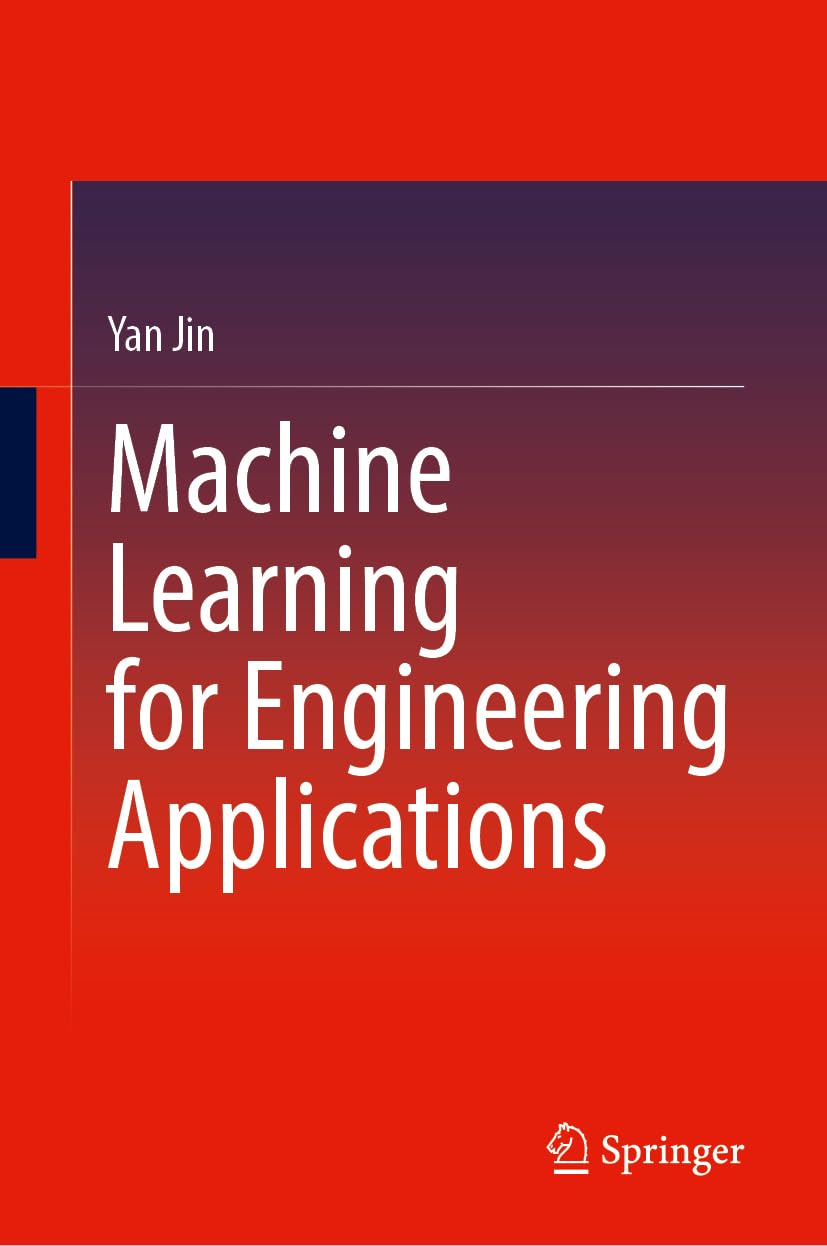
Written by Yan Jin, the book is designed for engineers who need more than an algorithm catalog. It develops the mathematical foundations, practical learning methods, and system-level judgment required to use machine learning responsibly in engineering work.
Designed around engineering judgment
The treatment combines data-driven learning with the physical knowledge, constraints, verification practices, and lifecycle considerations that distinguish engineering applications. Concepts move from mathematical formulation to implementation and then to interpretation in context.
Diamond Examples create short conceptual bridges between mathematics, machine learning, and engineering systems.
Application Examples develop complete engineering problems with data, Python implementation, results, and takeaways.
Engineering Takeaways emphasize assumptions, limitations, interpretation, and deployment consequences.
For learners
Build from the background you have.
Foundation chapters support readers who need to refresh linear algebra, probability, statistics, or optimization before moving into machine learning methods.
Explore learning pathwaysFor instructors
Adapt the book to the course you teach.
The companion manual supports semester, quarter, selective advanced-topic, and project-based course designs. Protected materials are available to verified instructors.
Review teaching supportPart I
Mathematical Foundations for Machine Learning
The mathematical language used throughout the book.
- 01
Introduction to AI and Machine Learning in Engineering
Places AI and machine learning within engineering practice, contrasting data-driven and model-driven approaches while establishing the book's learning design.
- AI and machine learning
- History of AI
- Modern engineering practice
- 02
Linear Algebra Essentials
Develops the vector, matrix, geometric, and decomposition tools used to represent engineering data and understand machine learning algorithms.
- Vectors and matrices
- Vector spaces and basis
- Norms and distance
- 03
Probability and Statistics Fundamentals
Builds the probabilistic language needed to describe uncertainty, summarize samples, perform inference, and evaluate relationships in engineering data.
- Sampling and descriptive statistics
- Probability
- Random variables and distributions
- 04
Optimization Basics
Introduces objectives, constraints, convexity, and numerical algorithms as the mathematical engine behind model training and engineering design decisions.
- Objectives and design variables
- Unconstrained optimization
- Constrained optimization
Part II
Machine Learning Concepts and Algorithms
From core learning paradigms to integrated engineering systems.
- 05
Introduction to Machine Learning
Establishes the core machine learning vocabulary, learning paradigms, generalization concepts, evaluation practices, and practical Python environment.
- Types of machine learning
- Features, labels, and models
- Empirical risk and generalization
- 06
Supervised Learning: Regression
Develops regression from linear models through nonlinear basis functions and regularization, with attention to diagnostics and engineering interpretation.
- Linear regression
- Parameter estimation
- Model diagnostics
- 07
Supervised Learning: Classification
Frames categorical prediction and compares interpretable, geometric, and instance-based classifiers for engineering decisions.
- Classification formulation
- Logistic regression
- Decision trees
- 08
Ensemble Methods
Explains how bagging, random forests, and boosting combine models to improve predictive performance, robustness, and interpretability.
- Bias and variance
- Bagging
- Random forests
- 09
Neural Networks and Deep Learning
Moves from artificial neurons and multilayer perceptrons to modern deep architectures, training practices, evaluation, and engineering deployment.
- Perceptrons and MLPs
- Activation functions
- Backpropagation
- 10
Unsupervised Learning
Introduces methods for discovering structure without labels, including clustering, dimensionality reduction, density estimation, and anomaly detection.
- K-means and hierarchical clustering
- DBSCAN
- PCA
- 11
Reinforcement Learning
Develops sequential decision-making from Markov decision processes through value, policy, actor-critic, and deep reinforcement learning methods.
- Markov decision processes
- Value functions
- Q-learning and SARSA
- 12
Generative Models
Surveys probabilistic and neural approaches that generate data, designs, and engineering assistance, including VAEs, GANs, diffusion models, and LLMs.
- Generative modeling concepts
- Variational autoencoders
- Generative adversarial networks
- 13
Physics-Informed Machine Learning
Combines governing equations, constraints, data, and learning algorithms to build models that respect engineering knowledge and limited-data conditions.
- Governing equations and constraints
- Physics-augmented losses
- Physics-informed neural networks
- 14
Specialized ML Techniques and Emergent Topics
Connects a broad set of specialized methods to engineering practice, from transfer and Bayesian learning to graphs, symbolic methods, agentic AI, and MLOps.
- Transfer and Bayesian learning
- Recommendation and association rules
- Graph learning
- 15
Integrating Machine Learning into Engineering Systems
Brings the methods together at system level, emphasizing paradigm selection, data-versus-physics tradeoffs, validation, deployment, trust, and human oversight.
- Algorithms to engineering decisions
- Paradigm selection
- Data-versus-physics design matrix
Get the book
Pre-order the hardcover edition.
Machine Learning for Engineering Applications is published by Springer and is scheduled for release on September 2, 2026. Availability, delivery dates, and pricing vary by retailer and destination.
- Format
- Hardcover
- ISBN-10
- 3032295114
- ISBN-13
- 9783032295118
- Publisher
- Springer
International ordering
Choose a bookseller in your region.
- Bookshop.orgUnited States
- Bookshop.orgUnited Kingdom
- Leslibraires.caCanada
- jpcGermany
- MichaelsbundGermany
- WilliamDamDenmark
- Lernmedien-ShopSwitzerland
- BertrandPortugal
- OkianRomania
- BokusSweden
- NorliNorway
- iMusicBrazil
Retailer listings are provided for convenience. The seller's current terms, price, taxes, shipping, and availability apply.